YouTube video listing
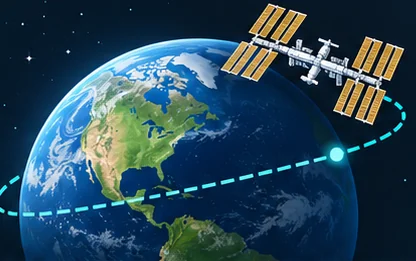
Earth from the ISS
Compare cloud patterns and the horizon.
Catalog: Sen 4K SpaceTV-1 Live Earth & Horizon from International Space Station
Open cameraPublisher source ↗
Explore Earth from orbit, compare space weather with conditions at the coast, and learn how scientists turn measurements into observations.
Open a selected camera in the existing Live Wall. Listings are matched to the catalog, not independently verified for current playback or field of view. Preview before classroom use; feeds may be offline, change direction or contain advertising.
Compare cloud patterns and the horizon.
Catalog: Sen 4K SpaceTV-1 Live Earth & Horizon from International Space Station
Open cameraPublisher source ↗Compare successive satellite images and their timestamps.
Catalog: NOAA GOES-19 Full-Disk Planet Earth Live Geostationary View (22,236 mi Orbit)
Open cameraPublisher source ↗Observe structures in extreme ultraviolet imagery; colors represent measurements.
Catalog: NASA SDO Space Telescope — Solar Corona Loops (171 Å Extreme UV)
Open cameraPublisher source ↗Reported measurements, not forecasts. Values are shown only when returned by the provider.
Open to request data.
Official source ↗Open to request data.
Official source ↗Open to request data.
Official source ↗Compare the Sun at different extreme ultraviolet wavelengths, then examine NOAA’s model of predicted auroral activity. These are publisher images, not continuous video. Read any observation or forecast time printed on the image; a retrieval time is not an observation time.
Images load only on request.
Not requested.
Trace loops of hot plasma along magnetic structures.
Not requested.
Compare bright structures and prominences with the 171 Å image.
Not requested.
Model forecast, not a photograph or guarantee of local visibility. Clouds, daylight and viewing location matter.
Why do two images of the same Sun look different? Color in extreme ultraviolet imagery represents measured wavelengths rather than what a human eye would see. Compare the forecast with the planetary Kp observation above; neither alone establishes whether an aurora is visible from a particular town.
Collect successive reported positions at least one minute apart. This is a session observation log, not an orbital prediction or a continuous ground track. Longitude can jump at the international date line.
No samples yet.
Compare latitude and longitude at two different times. Explain why a straight line on a flat map may misrepresent motion on a globe.
The ISS circles Earth in about 90 minutes. Its location changes as both the station and Earth move.
Open mapThe planetary Kp index runs from 0 to 9. NOAA identifies geomagnetic storm levels G1–G5 beginning at Kp 5. An index is not a forecast of aurora at your location.
NOAA Kp index ↗Water levels are measured relative to a reference datum. Wind, waves and water temperature describe different properties of the ocean.
Explore buoy observations ↗Record the date, local or UTC time, source and your observations. A blank feed is not evidence that nothing happened.
External sources open separately and may have their own availability or access rules. Preview live content before using it with students.
Suggested activities; adapt to student readiness and available observations.
Find Earth and the space station in the observation tools.
Compare two ISS positions and record the elapsed time.
Use successive positions to discuss why a ground track is not the same as orbital distance.
Find short camera-connected activities and an observation worksheet.
Virtual field trips & educator resources